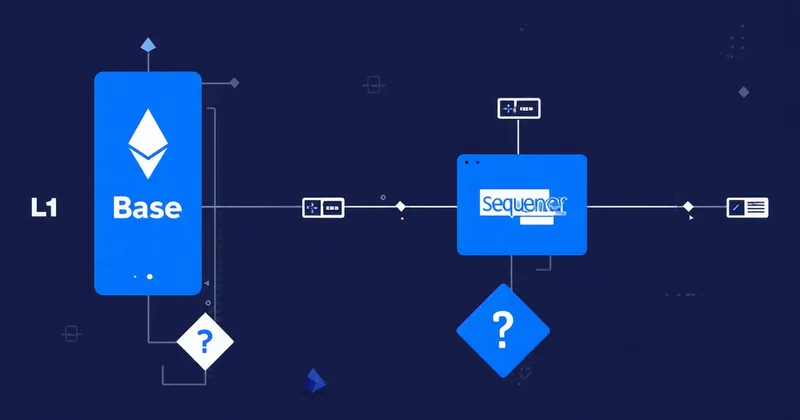
Base is an OP Stack chain. That architectural choice is transparent and publicly documented. What's less commonly understood is what the single-sequencer model actually means for your transaction in practice — specifically, the gap between "my wallet submitted a transaction" and "my transaction is on Base," and what can go wrong in that gap.
Most DeFi traders treat Base as a normal EVM chain: sign a transaction, submit to RPC, wait for confirmation. This works fine under normal conditions. Where it breaks down is in understanding what "confirmation" actually means, how to verify that your transaction went where you intended, and what happens when the sequencer is the adversarial party in your threat model.
The sequencer's role in the OP Stack architecture
Base operates with a single sequencer run by Coinbase. The sequencer receives transactions from users, orders them into blocks, and posts batches of those blocks to Ethereum L1 via the BatchInbox address on mainnet. Until the batch is posted and the L1 transaction is confirmed, your L2 transaction is "soft confirmed" — the sequencer has included it in a block, but it has not yet achieved the L1-backed safety guarantees of a fully settled transaction.
The sequencer has discretion over transaction ordering within each batch. Under the current Base implementation, the sequencer does not have a published mempool — transactions submitted directly to the sequencer RPC are not broadcast to other nodes before inclusion. This means you cannot verify that your transaction was ordered fairly relative to other transactions by inspecting a public mempool. You submit to the sequencer, the sequencer decides where in the block your transaction sits, and you find out afterward.
This is not unique to Base; it's a property of all current OP Stack implementations. The practical implication for traders is that front-running and transaction reordering are possible at the sequencer level in a way that's not possible on a chain with a distributed mempool and PBS (Proposer-Builder Separation) style separation of concerns.
Force-include via L1: your safety valve
The most important piece of OP Stack architecture for traders to understand is the force-include mechanism. If the Base sequencer excludes your transaction — either by censoring it deliberately or by going offline — you have a path to get it included via L1.
The OptimismPortal contract on Ethereum mainnet has a depositTransaction function. Transactions submitted through this function are guaranteed to be included in the L2 chain within a defined window (currently 12 hours on Base) even if the sequencer ignores them. The mechanism works because L2 full nodes watch L1 for these deposit transactions and process them regardless of the sequencer's block production.
The practical flow: if your Base transaction is stuck or you have reason to believe the sequencer is excluding it, you can construct an equivalent transaction via depositTransaction on L1 using the cross-domain messaging interface. The transaction will arrive on L2 as a "system deposit" transaction, with different gas mechanics but guaranteed inclusion. This does not require any permission from Coinbase.
We're not saying force-include is something you'll use in normal operations — under current conditions, the Base sequencer has maintained high availability and there's no documented evidence of systematic censorship. But understanding that the escape hatch exists changes your risk model. You are not fully dependent on the sequencer's goodwill to access your funds or complete a transaction.
Verifying your transaction reached L2 — not just the RPC
When you submit a transaction through a Base RPC and receive a transaction hash, what you've confirmed is that the sequencer's mempool acknowledged receipt. This is not the same as confirmation that the transaction has been included in an L2 block, and it's certainly not confirmation that the L2 block has been batched to L1.
The verification hierarchy for a Base transaction has three levels:
- Unsafe: transaction is in the sequencer's local chain but not yet derived from L1 data. Visible via standard RPC calls. Reorgable if the sequencer is replaced.
- Safe: transaction's batch has been posted to L1 but not yet finalized (pending L1 finality). The sequencer cannot unilaterally reorg this.
- Finalized: the L1 blocks containing the batch are finalized. Economically irreversible under normal consensus assumptions.
Standard EVM transaction receipt calls return the unsafe confirmation by default. If you're moving significant value and need to verify the transaction's actual settlement state, you need to check L2 block safety against L1. The optimism_syncStatus RPC method returns the current unsafe/safe/finalized head heights. For high-value operations, checking that your transaction's L2 block number is at or below the safe head before treating funds as fully settled is the correct practice.
Chain ID handling on Base and OP Stack forks
Base's chain ID is 8453 (0x2105). This is distinct from OP Mainnet (10, 0xa), Optimism Sepolia, Base Sepolia, and other OP Stack deployments. Because OP Stack makes it relatively straightforward to fork and deploy a new L2, there are dozens of OP Stack chains with varying degrees of activity and legitimacy.
An adversarial RPC scenario specific to OP Stack: an endpoint that serves Base chain ID 0x2105 in response to eth_chainId but routes submitted transactions to a different, attacker-controlled OP Stack chain. Since OP Stack chains share EVM compatibility and can have identical contract addresses (especially for protocol deployments), a transaction that lands on the wrong OP Stack chain may look valid — same contract, same function, same addresses — while having no economic connection to the funds on the real Base chain.
The check is the same as for any EVM chain: verify chain ID before signing, verify chain ID again via an independent RPC before broadcast. One RPC call is not sufficient; if that one RPC is the malicious one, the check is trivially spoofed. The defense is comparison across independent endpoints.
What the centralized sequencer doesn't change about your signing security
The Base sequencer model is worth understanding, but it doesn't change the fundamental premise of transaction signing security: the signature you produce with your hardware wallet should reflect the exact transaction that gets executed. Whether that transaction is ordered at position 3 or position 300 in a block, it executes the calldata you signed — no more, no less. The sequencer can reorder but cannot modify the content of signed transactions.
The signing-level risk on Base is the same as on any EVM chain: wrong chain ID in the signing payload, wrong calldata, wrong recipient — all of which are fixed at signing time and cannot be altered by the sequencer afterward. Understanding the sequencer's role matters for finality and ordering; it doesn't alter the calldata verification requirement at the moment of signing. Both problems exist independently and both require their own mitigation.